
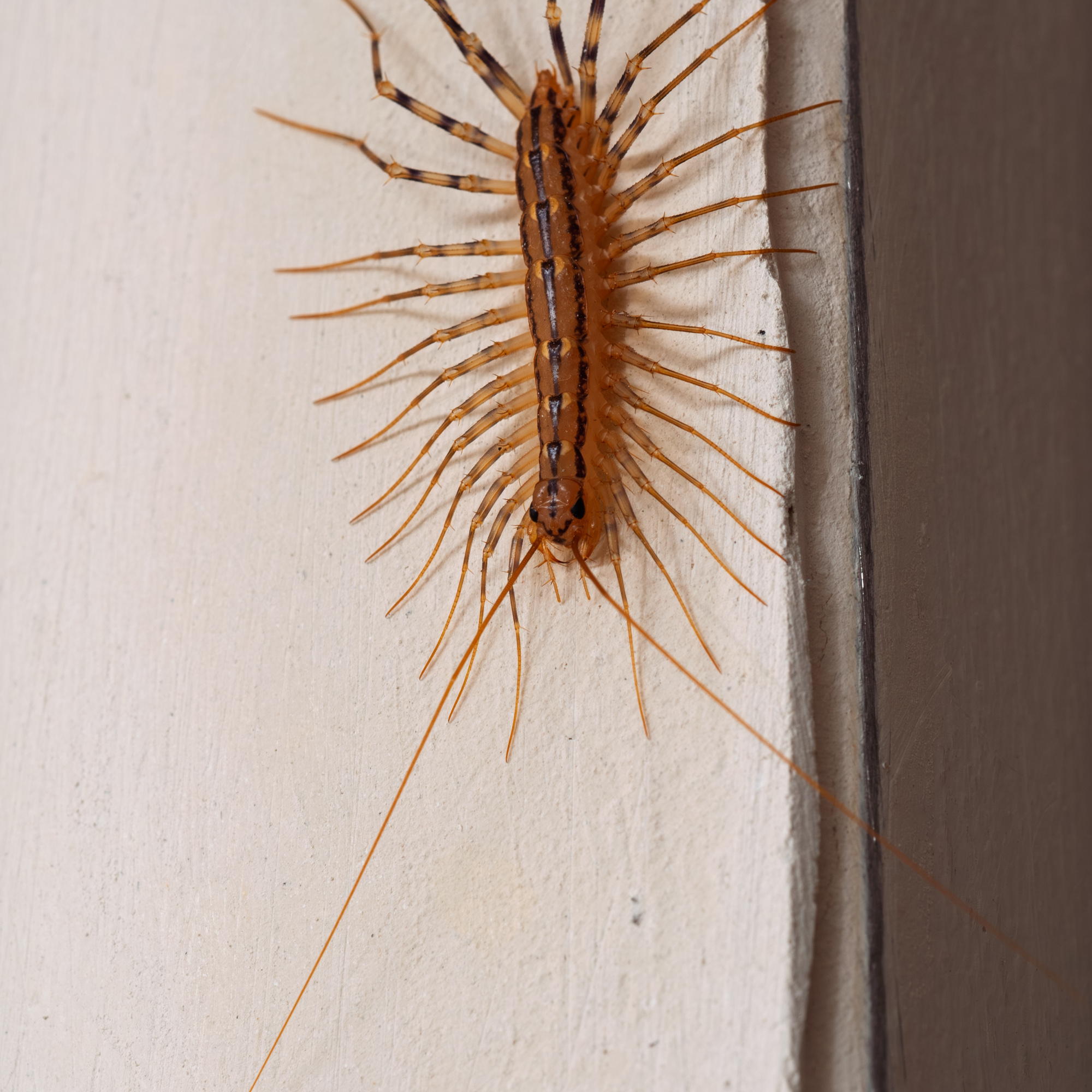

A quick flash of legs across the bathroom tile at 2 a.m. is the first real sign a centipede found its way in, and August is when we hear about it the most. Tucson’s monsoon rain has kept the ground outside wet for weeks, and centipedes in AZ don’t need much of it to stay comfortable. Once that rain starts tapering off toward the end of summer, the moisture they’ve been living on outside dries up faster than it does indoors, and a bathroom or laundry room starts looking like the better option.
What Brings Centipedes Inside Once the Rain Slows
Outdoors, a centipede spends most of its time under loose bark, rotting wood, or a pile of leaves pressed against the house. All three hold onto moisture longer than open ground does, which is exactly what a centipede needs to stay active. Once the yard starts drying out in August, those hiding spots stop working as well, and the nearest damp equivalent tends to be somewhere inside.
Older neighborhoods with mature landscaping tend to see this shift earlier than newer builds with gravel yards, mostly because there’s more leaf litter and irrigated planting beds holding onto moisture right up until the rain stops. A yard that’s been damp all monsoon season doesn’t dry out overnight, so the migration indoors tends to stretch across several weeks rather than happening all at once.
Moisture They’re Chasing
A leaking pipe under a sink, a poorly ventilated bathroom, or a laundry room that never quite dries out between loads gives a centipede exactly what it lost outside. Fix the moisture problem and the centipede loses interest along with it. The bug is rarely the actual issue; the damp spot underneath it is.
What a House Centipede Looks Like
House centipedes have a body built for speed, which throws people off since most home-invading bugs don’t move that fast. They carry one pair of legs per body segment, and depending on the species that adds up anywhere from 15 pairs to well over a hundred, always an odd number no matter how the count lands. Arizona’s largest species can stretch close to 8 inches, which is enough to make anyone’s stomach drop the first time one shows up on a wall. For a closer look at what we see most locally, our centipede page breaks down the difference between the harmless kinds and the larger Scolopendra worth being more careful around.
Not the Same as a Millipede
A millipede moves in a slow, rolling wave and curls into a tight spiral when it’s bothered. A centipede does neither. It moves in fast, erratic bursts and flattens out low to the ground instead of curling up, and that speed alone is enough to tell the two apart without getting close enough to count legs.
Should You Worry About a Centipede Bite?
Centipedes have poison jaws built for hunting, not for people, and they use them on the flies, spiders, and other small bugs that make up most of their diet. A bite on a person happens only when one feels cornered or mistakes a hand for something it can eat, and even then the result looks and feels a lot like a bee sting: localized pain and some swelling that fades within a day or two.
When a Bite Happens
Most centipede bites we hear about start with someone reaching into a shoe, a folded towel, or a stack of boxes in the garage without checking first. That’s less about the centipede being aggressive and more about it feeling trapped with nowhere else to go. Washing the area with soap and water and applying a cold compress handles most bites just fine. Nausea, vomiting, or fever from a bite is rare enough that it’s not the main concern here. The bigger issue is just how unsettling it is to find one in the first place.
Where They Turn Up Indoors
Bathrooms top the list for an obvious reason: consistent moisture, a drain, and usually a potted plant nearby that gets watered on a schedule. Basements and crawlspaces come in close behind, especially ones with poor airflow or an older foundation that lets in ground moisture. A centipede showing up in one of these spots isn’t alone. Where there’s one, there’s often a smaller bug population nearby that brought it there first.
A few spots account for most of the sightings we get calls about:
- A bathroom with a shower that never fully drains
- Check a laundry room for a hose connection that sweats or drips
- Crawlspaces with exposed dirt instead of a vapor barrier
- Firewood or boxes stacked directly against an exterior wall
Spaces That Stay Damp Longest
None of these spots are unique to centipedes specifically, but they’re exactly the conditions that keep one around instead of passing through. A single centipede in a dry, well-lit room leaves the way it came in on its own. One found repeatedly in the same damp corner is a different story, and that corner is worth checking for a moisture source before doing anything else.
Keeping Centipedes From Becoming a Regular Sight
Getting rid of centipedes in the house for good means dealing with the moisture and the bugs they’re hunting, not the centipede itself. It’s less about any single fix and more about closing off the handful of conditions that keep bringing them back.
What Cuts Their Numbers
A few fixes make the biggest difference once the moisture problem is handled:
- Running a dehumidifier in a bathroom or laundry room that stays humid after use cuts off the moisture centipedes need most
- A dripping pipe or slow drain left unchecked becomes a standing water source soon enough
- Seal gaps around weep holes, door sweeps, and utility lines before the next round of rain
- If mulch or leaf litter is piled against the foundation, it gives centipedes a bridge straight to the exterior wall
Reducing the smaller insects they feed on matters just as much, since a centipede with nothing to hunt indoors won’t stick around regardless of how damp a room stays. Our residential pest control program addresses both sides of that at once, cutting off the bugs a centipede feeds on and sealing the gaps it would otherwise use to get inside.
Book Centipede Control Today
A centipede indoors in August is more about the moisture it’s chasing than the bug itself, and that moisture doesn’t go away on its own once the rain stops. If centipedes have been showing up more than once in the same room, call GreenShield Pest Control at 520-393-3352 or reach out through our contact page and we’ll get an inspection scheduled.
We proudly serve homes and businesses throughout Pima and Cochise counties, including:
- Benson
- Marana
- Tucson
- Sahuarita
- Oro Valley
- Vail
- Green Valley
- Sierra Vista